Home Posts filed under >Julie Taymor
 While Julie Taymor's getting geeks' panties in a bunch for her gestating "Spider-Man" Broadway show, her latest endeavor in cinema is an adaptation of William Shakespeare's "The Tempest," with an estimable cast that includes Helen Mirren, Alfred Molina, Chris Cooper, Alan Cumming, Russel Brand, and Ben Wishaw to name a few. Taymor's no stranger to Shakespeare's work, as her last cinematic foray into his oeuvre was her adaptation of "Titus Andronicus," shortened simply to "Titus" way back in 1999 with Anthony Hopkins in the title role. Adding to her experience is the fact that she had already done "The Tempest" on three difference occasions, so suffice to say, she probably knows the piece like the back of her hand.
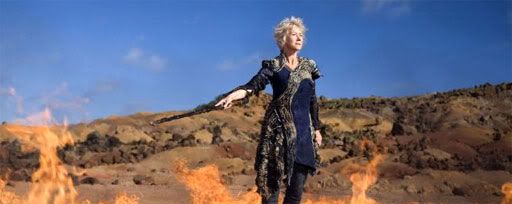
This time, however, the director wasn't interested in completely sticking to the script, which called for what is essentially the main character of Prospero to be played by a male actor. Instead, Helen Mirren expressed interest, and the two were careful with the decision to gender swap. "We did a reading a year in advance, it was extremely critical to both Helen and myself that this not be a gimmick, that putting a woman into this role had validity for the Shakespeare play," said Taymor at the New York Film Festival press conference. Would she really turn down a performance by great thespian Mirren? It's doubtful, but the concern is understood and shows that the female filmmaker's head was in the right place during pre-production, recognizing that the change would call attention, and so it would be necessary to avoid it being a mere contrivance. The swap, in fact, gave certain scenes a different and deeper layer. She spoke of one of the final scenes, where Prospera relinquished her magic and shed her island dwelling appearance for a more regal one. "When you watch her go from these androgynous free clothes that you'd wear on an island to be comfortable, back into that severe female corset, she's not just giving up her magic, she's giving up her freedom for her daughter's."
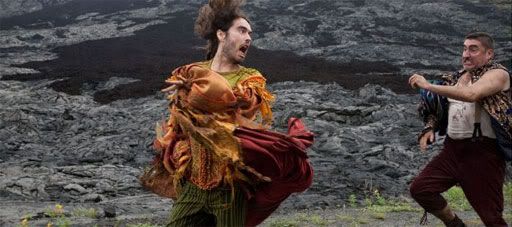
These visual moments were sought out by Taymor, who said, "I wanted to have certain moments of breathers from the language." And indeed, while the film version has been whittled down from a play that's roughly 4 hours in its entirety, there's still a plethora of dialogue to be digested — which she acknowledges as hard to break up because of its specific rhythm. Instead, she expounded on the newly opened doors that the film medium had presented her, such as the previously mentioned scene and the focus on the costume design. And also the environment the characters inhabit, which directly represented their feelings or the theme of a particular scene:"When the king falls asleep," she explains, "we're in this incredible iron wood forest that we would get lost in. We're doing a conspiracy here, so we need to find a place for these actors to hide, for these actors to go. When the clowns get drunk, they're in what we call the 'Ramble Forest' and it's all gnarled and it looks like 'Hansel and Gretel' and it's like what's going inside of them."
In particular, Taymor found inspiration in the 1964 near-perfect Hiroshi Teshigahara film "Woman in the Dunes," in which an unwilling couple live in a sand-dune with no way out. "I never lost the love for this film, where the two lovers were down in a pit and everyone was watching from above. They couldn't get out because it forced them into that incredible sexual moment. It pushes the two together, every piece of scenery was used to represent inner landscape."
 Those especially familiar with the play also know that it's very musical, with the spirit Ariel, played by Ben Wishaw, performing many songs. No stranger to contemporary musicals, having directed the Beatles-inspired "Across the Universe," Taymor and her constant collaborative composer Elliot Goldenthal opted for something a little different from the norm. Goldenthal still used many instruments of the time, such as didgeridoos and wood flutes, but they spoke of blending in current styles while still keeping the atmosphere of what they would've used around the birth of the play.
 "We talked about this combination of contemporary sensibility and electric guitar. 'The Tempest' does have orchestral elements, but a lot of those elements are electric guitar. He uses (these) as an orchestra. I wanted to bridge time."
Bridge time she did, as the conclucsion features the final monologue by Prospera as sung by Beth Gibbons, lead singer of the band Portishead. The closing speech was originally scrapped by Taymor, but when it came down to it, she realized it was incomplete without it. With no money left, she and her producers tried to come up with clever ideas to fit it back in, and a song by Gibbons just happened to be the idea that won. "Beth came to mind because she feels like Helen to me. She has the vulnerability and the power simultaneously." The finale song puts a proper close on things, and amusingly enough, some even thought that it actually was Mirren's voice over the music. "Some people think that it's Helen singing, but Helen will tell you that she doesn't sing."
Whether Taymor succeeds in attracting audiences to her mix of past and present elements remains to be seen, as regular joe moviegoers (and honestly, even those into the art of cinema) often find the density and general wordiness of Shakespeare films to be a bit exasperating. The director seemed to be confident with her film and very adamant about her choice, simply stating "I didn't want to update it. Shakespeare is all-time."
"The Tempest" opens December 10, 2010.
 Everything associated with Julie Taymor's "The Tempest," at least in the initial build-up of pre-release hype, has been built around the faux-provocation of Helen Mirren, distinguished British film actress, multiple award winner, Queen of England, playing Prospero, a character that has traditionally been portrayed as being male, in Shakespeare's classic play. (In the new movie, she's now called Prospera.) It's only after you've been watching the movie for a few minutes, after you take in the changes in the character (if you're a Shakespeare fan or graduated with a Literary Studies degree), that the momentary thrill subsides and then vanishes altogether. The reason all the hype is centered around this slightly oddball casting decision is because there's nothing else to sell the rest of "The Tempest" on.
Which is to say: "The Tempest" is bad. Like, really, really bad.
But it does have a nice title card: large, crisp font, taking up much of the screen, superimposed over the arresting, surreal image of a tiny sandcastle in the palm of a young girl's hand. But once this image is gone, and it's gone fairly quickly, the goofy overwrought nightmare that is "The Tempest" consumes you.  "The Tempest" is considered, at least by Taymor herself, to be one of Shakespeare's "greats." In her movie, Prospera is a would-be duchess who has been banished to an inhospitable island to live with her child (played by the apple-cheeked Felicity Jones) after charges of witchcraft are leveled against her. When the film opens, it's been 12 years since her banishment, and, using her keen mastery of both science and magic, as well as her friendship with an androgynous nature sprite named Ariel (Ben Whishaw), she maroons those who conspired against her on the same forbidding isle. Said conspirators include King of Naples Alonzo (David Strathairn) and Alonzo's brother and son (Chris Cooper and Alan Cumming). Also on the island: a pair of bumbling drunks (Alfred Molina and Russell Brand) and the island's natural inhabitant Caliban (Djimon Hounsou).
The plot is classically Shakespearean, with the three threads interweaving haphazardly throughout until they all reconcile at the end, with a message that is less about vengeance and more about forgiveness and moving on. A nice sentiment that still resonates four hundred years later. (There's also some stuff about Prospera's daughter getting involved with Ferdinand, played by Reeve Carney, but those are probably the dopiest sections of the already dopey movie.) It's clear what a huge mess "The Tempest" is from very early on, with the titular storm bearing down on the conspirators' ship. It's well photographed by cinematographer Stuart Dryburgh, with the action being staged not unlike something from the latter "Pirates of the Caribbean" movies. At this point, the score by Eliot Goldenthal hasn't gotten too overbearing. Yes, it's a bit much, but it's a couple of scenes later, when Prospera is going over the attack with Ariel, do we realize just how awful this is going to be. As Ariel recounts the storm, we see him gliding above the ship, laughing maniacally, with Goldenthal's music mutates into some kind of acid rock mutation, with gnarled electric guitars raging; the word "embarrassing" comes to mind.
But, amazingly, this is the tip of the bad-taste iceberg, as throughout the film, Taymor takes advantage of the digital visual effects she fell in love with on her borderline unwatchable Beatles jukebox musical "Across the Universe," to turn Ariel into a swarm of frogs, a giant crow, and a pack of flame-breathing dogs. The effects, supervised by the amazing title designer Kyle Cooper, have an ethereal look that doesn't conjure magical surrealism but a rather a liquidy impermanence. All the while, Ben Whishaw, a normally fine actor, does his best to look dignified, even when his face is being digitally painted into the trunk of a tree and his hair has more product in it than the entire cast of "Jersey Shore" (he looks slightly electrocuted). As far as casting goes, Whishaw is one of the better calls. Chris Cooper seems wildly out-of-place, but then gets into a groove with his character; by the end of the film you'll be glad he was there, because he seemed to add a little bit of authenticity and humanity to a movie that seemed more concerned with its glitzy visual effects and elaborate costumes than with emotional connectivity. Mirren is wonderful, of course, but spends stretches of the movie off-camera. That was sort of a given. It should, however, be noted that there hasn't been a recent example of sticking-out-like-a-sore-thumb casting as shameful as Russell Brand's. His performance, as the bumbling clown, is supposed to be a little larger than life. Every time he shows up it's like somebody has painted a yellow slash down the center of the screen; it's distracting, off-putting and awful.
Taymor keeps large sections of the text, and outfits her characters in decadent duds (we'd kill for one of those YSL-ish leather jackets) that she said were meant to symbolize timelessness. What they really symbolize is a director more comfortable with camp than with craft, and the way she shoots much of the movie, with the actors taking up the foreground of the shot while the backgrounds (the movie was shot on location in Hawaii) turn into indistinct mush, robs the movie of any sense of scope. It becomes less about the text, the amazing actors that are saying the lines, and the scale afforded by motion pictures, and more about Taymor's lackluster staging.
Bogglingly, "The Tempest" is the "Centerpiece Film" at the New York Film Festival and closed out Venice earlier this year and is being groomed by some as an Oscar heavyweight, once it opens in December. It's absolute absurd to think this, and we're quick to peg it as this year's "Nine:" a movie that seems to have prestige written all over it, until people actually see it. Or, in the words of the Bard: "the past is prologue." [D]
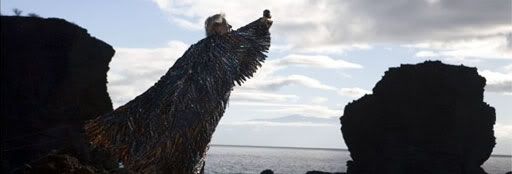 Those especially familiar with the play also know that it's very musical, with the spirit Ariel, played by Ben Wishaw, performing many songs. No stranger to contemporary musicals, having directed the Beatles-inspired "Across the Universe," Taymor and her constant collaborative composer Elliot Goldenthal opted for something a little different from the norm. Goldenthal still used many instruments of the time, such as didgeridoos and wood flutes, but they spoke of blending in current styles while still keeping the atmosphere of what they would've used around the birth of the play.