Home Posts filed under >Melissa Leo
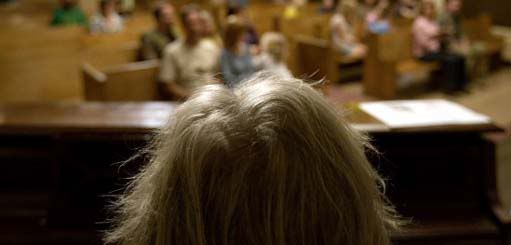
 Kevin Smith has done pretty admirably so far in keeping things mum surrounding his upcoming horror flick "Red State." But we suppose it was only a matter of time before he hit Twitter to answer questions about the film as well as answer a world of questions recently about his "Christploitation" flick.
The director revealed that the film will come in at a very succinct "80 or 85 mins, when all's said & done." He's been shooting the film more or less in chronological order saying, "We're at around 52 minutes right now, with 8 days left to shoot." He hopes to show the film to the entire cast and crew at the wrap party, and it looks like he wants it out there making the festival rounds quickly. The film is without a distributor for now but will head to "Sundance in January, if possible. From there, we'll see the lay of the land."
As for the actual film itself, Smith says "Act 2 is all about self-sufficiency: relying solely on one's own abilities to achieve & satisfy. No more intermediates; no more middle-men." Sounds like a Diddy tweet. He also adds, "In the 70's, they made exploitation flicks about devil worship. We flip it on RED STATE - so it's an exploitation flick about angel worship."
You know what? This might be the first Kevin Smith film we're actually curious about in years. It definitely sounds like an intriguing project, and one that finds him finally stepping out of the tired comfort zone of bathroom rumor he's been rutted in for the last little while. Kevin Pollack, Michael Parks, Kyle Gallner, Melissa Leo, Michael Angarano, Steven Root and John Goodman star in the film that will most likely hit theaters sometime next year. [JoBlo]
 It’s important to have a fresh perspective on every film. With a number of films being released each week, the insight into why they were made and what they say about our society is invaluable, even if the major studios have done their part to crush the auteur theory. That is no such consolation for us regarding “Conviction,” however, a film with familiar missteps, one that fails to connect in a manner we should all be familiar with. You probably saw a “Conviction” last weekend on Showtime, and your parents will probably make you watch a “Conviction” when you visit them for the holidays.
“Conviction” is an improbable true story about a union between brother and sister. Betty Anne and Kenny Waters grew up as latchkey kids, breaking into homes in their working-class Massachusetts neighborhood and gaining a reputation as troublemakers. Eventually, foster care changed both, as they took divergent paths. Betty became a self-serious family woman, marrying with two children. Kenneth apparently tried to walk the straight and narrow by peppering petty crimes around his daily lifestyle, and as such develops a relationship with local law enforcement.
 This relationship proves harmful when Kenneth is taken in for a murder charge. There is limited evidence, but in the years before widespread DNA specialization, it doesn’t look promising that no one can verify Kenneth’s alibi. Two years after the murder, Kenneth is finally prosecuted. People can’t finger him at the crime scene, but they certainly know what he’s not, and with his rap sheet and cavalier demeanor, Kenneth easily goes away for a lifetime sentence. Here, Betty swears to him he’ll get him out. And that involves chasing a box.
The literal-minded film then goes about following Betty clawing her way through college and law school while caring for her two boys. Her husband is played by Loren Dean, the kind of actor who gives away his entire purpose in the film once you see his tight, humorless face in this context. He is immediately against fighting the system from the inside, for reasons we never learn, and the movie quickly sidesteps him twenty minutes in, never to be heard from again. Betty’s plan is crazy, of course, but her motivation remains clear, and it’s a symbol of the bond between the two, which would come across stronger if everyone opposing her decision wasn’t seen as an overt “bad guy” without reasonable doubt.
 Once she passes the bar, the box in question is the film’s holy grail. This is the box of evidence in Kenneth’s case, significant to no lawyers in America save for Betty Anne. Unfortunately, the box itself remains shrouded in mystery -- Massachusetts state law orders the disposal of all evidence within a decade of the trial -- so Betty Anne does everything in her power to find such a box. Inflated through the prism of big screen courtroom drama, it’s meant to be a breathless battle for the truth, but it’s hard to ignore the darkly comical idea of the truth lying in a four-by-four box in a darkened room like a mystical weapon.
Does she find it? We’re unsure as to what we should spoil, and so is the movie. There are difficulties within adapting true stories because you realize the audience probably has a good idea how the story resolves itself. “Conviction” throws a curve ball of questionable necessity, refusing to truly exonerate Kenneth for the murder charge. Betty is convinced of his innocence, but the audience never sees him at work, where he was during the murder, and where he left without being seen, his time card somehow vanishing. Combined with the bursts of violence and aggression from the convict, played by a volatile Sam Rockwell, the main source of suspense in the film revolves around the possibility that he’s a murderer. When the scenes without Kenneth have a flat TV feel, with mild performances and mundane administrative challenges, the realization is that this is a cheap tactic necessary to inflate a straightforward story.
 Rockwell is of course the highlight of the film, but that’s become consistently true enough that it needs not to be said. His Kenneth is rambunctious and spirited, but not without a darkness. Even when he’s joking or dancing (the latter a foregone conclusion in his films), there is the threat he’s going to behave dangerously. Rockwell’s physical transformation is particularly intriguing, as his muscles become puffy and his hair thins, the last remnants of the old Kenneth in his sunken eyes, the only way he can communicate to Betty weekly that he’s not fit for prison. As Betty, the humorless Hilary Swank is a non-entity when sharing a scene with Rockwell, and without him, the sturm und drang of the story give her only two emotions to play, driven and angry. It’s safe to say that anything in “Conviction” without Rockwell is a slog.
Tony Goldwyn comes across as a filmmaker who unequivocally loves this story. Scenes of Betty Anne and Kenneth are children are bathed in a golden light, while as adults, the two never have anything more than a mild disagreement, so strong is their bond. Furthermore, there are good guys and bad guys in this story. Betty Anne’s DNA research is aided by dashing good guy lawyer Peter Gallagher and his heroic hair, while Betty Anne’s kids have only momentary dispute with what she’s doing, usually helping by making breakfast and coffee and providing moral support when they probably should be going to school or making friends. Opposing them are characters like Melissa Leo’s cartoonishly remorseless cop who takes Kenneth in, all bluster and schoolmarm-ish self-righteousness, while Kenneth’s ex-girlfriends who testify against him end up as catatonic single mothers (Clea Duvall, playing much older) or raving junkies (Juliette Lewis, playing Gollum).
 As a result, Goldwyn hasn’t become close to this story as much as he’s gravitated directly towards the justice dealt out. No matter what kind of people Betty Anne Waters and Kenneth were, Goldwyn did them a favor, as the film remains a singleminded, achingly literal tale of one brother and one sister fighting injustice. It’s someone trying to make a movie about humans (complete with a terrible, overbearing score from Paul Cantelon) and instead falling in love with the story of the system, the objectives crossed off a checklist while character and nuance fall by the wayside. It’s TV, in other words. And not even HBO. [C-]
 The soundtrack to "Welcome to the Rileys," which mostly features a score by Marc Streitenfeld, hits digitally October 26 and physically November 2 via Lakeshore Records.
Directed by Jake Scott (the son of Ridley Scott), the film stars Kristen Stewart, James Gandolfini, Melissa Leo, David Jensen, and centers on a damaged man (Gandolfini) on a business trip to New Orleans who seeks salvation by caring for a wayward young stripper (Stewart). The soundtrack does also feature the Ying Yang Twins' "Jigglin" and "URA Fever" by The Kills, both of which are played in the strip club where Stewart's character works (don't get too excited, while it's Rated R, we're pretty sure you see no K-Stew skin).
Originally scheduled for a November 5 release in theaters, the film was recently bumped up one week to a October 29 date. You can watch the trailer here and you can see the tracklist below.
"Welcome to the Rileys" tracklist
01. Welcome To The Rileys – Marc Streitenfeld
02. Rebirth – Marc Streitenfeld
03. I Am Here – Marc Streitenfeld
04. Walking In New Orleans – Marc Streitenfeld
05. Alive – Marc Streitenfeld
06. Trouble Sleeping – Marc Streitenfeld
07. Private Parts – Marc Streitenfeld
08. Headstone – Marc Streitenfeld
09. Time – Marc Streitenfeld
10. On The Road – Marc Streitenfeld
11. Nobody's Little Girl – Marc Streitenfeld
12. End Title - Walking Reprise – Marc Streitenfeld
13. Going Up The Country - Kitty Daisy And Lewis
14. Go Down, Sunshine - Odetta
15. Teenager’s Prayer - Joe Simon
16. Le Disko - Shiny Toy Guns
17. U.R.A. Fever - The Kills
18. Jigglin - Ying Yang Twins
 Kevin Smith has done pretty admirably so far in keeping things mum surrounding his upcoming horror flick "Red State." But we suppose it was only a matter of time before he hit Twitter to answer questions about the film as well as answer a world of questions recently about his "Christploitation" flick.


