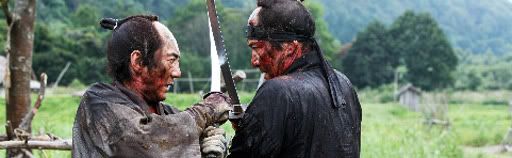
 Controversial Japanese filmmaker Takashi Miike of late seems to have slowed down his ridiculously prolific pace. Just check his IMDB profile and you'll see. The man must love to make movies, but it's welcome to see him take a more contemplative approach to his filmmaking. Ok, contemplative may be the wrong word to describe the gonzo genre Japanese filmmaker, as he's now down to a more manageable (for him, we guess) two, three films in a year, but "13 Assassins" must have benefited from time.
Miike has fashioned one hell of a rousing piece of entertainment. It's easily his most accessible film to date, which if you're a big fan of "Ichi the Killer," "Audition," "Gozu" and/or "Dead or Alive" means you may find a more (relatively) subdued Miike not to your liking. But if you hated his clusterfuck of a western "Sukiyaki Western Django," as this writer did ("The Good, the Bad, The Weird" did pretty much the same thing so much better), then this latest effort, a punkish yet traditional samurai film, will be a welcome return to comprehension.
 The set-up and build-up is similar to "Seven Samurai." It's 1844, at least 20 years before the overthrow of the shogunate. It's a peaceful time, which means most of the best samurai are bored with nobody to fight. Climbing the political ladder is the nasty, murderous villain Lord Naritsugu (Inagaki Goro, having fun playing a prototypical Miike character aka someone with no regard for human life and decency). The elder council decides to act against the Lord before he attains too much power. The squad is picked for the mission, and the twelve set their plan in motion, train for the big battle, and pick up the final member later on, a goofy, perhaps ghostly(?) non-samurai who wants to fight anyway (Iseyaa Yuseki, essentially playing the Toshiro Mifune role from "Seven Samurai" here).
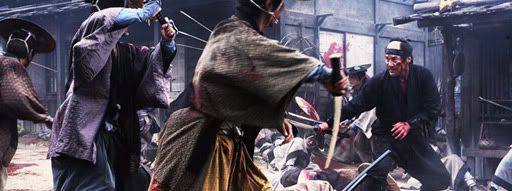
 What follows from that jumping off point — the payoff — is deserving of more than a single paragraph. For lack of a better description, it's pretty fucking awesome. Without a stopwatch one can't be sure, but it's safe to say the final battle, our 13 heroes vs. 200 of Naritsugu's soldiers, approaches if not exceeds the hour-long mark, with never so much as a lull the entire time. Miike essentially takes the approach described in Frank Miller's "The Big Fat Kill," turning the town of Ochiai in to a bottleneck where the bad guys are sitting ducks. It's impressive, especially when compared to something like Neil Marshall's lame and downright boring "Centurion" with its endless shots of people running and fight scenes that lose steam after 30 seconds in lazy repetitious blood splatter.
Not so for "13 Assassins." The blood flows, but something Miike understands about the genre is that each character — while admittedly rather indistinguishable due to lack of proper development — brings with them a distinct fighting style. Miike also understands the tropes of the samurai film, and breaks free of some, but also embraces rather too many for this writer's taste. For every classic-Miike well-framed decapitation and river of blood spilled (one hilarious moment recalls the pit scene from "Army of Darkness," where an impossible geyser of blood shoots out from a well-placed explosion), there's double that in cliches: men die during battle and everyone stops to watch instead of continuing to fight, the inevitable deaths of almost every character (wouldn't it be fresh if most survived?), and the final showdown between the lead assassin and the baddy. It lends the film a sense of compromise, or at least it feels like Miike is catering too much to the audience, happy to give the people what they want. It's just goofy enough, and well-made enough, though, to overcome most of these shortcomings. [B]


No comments:
Post a Comment